Edgar Mansfield: The Life Within Bronze
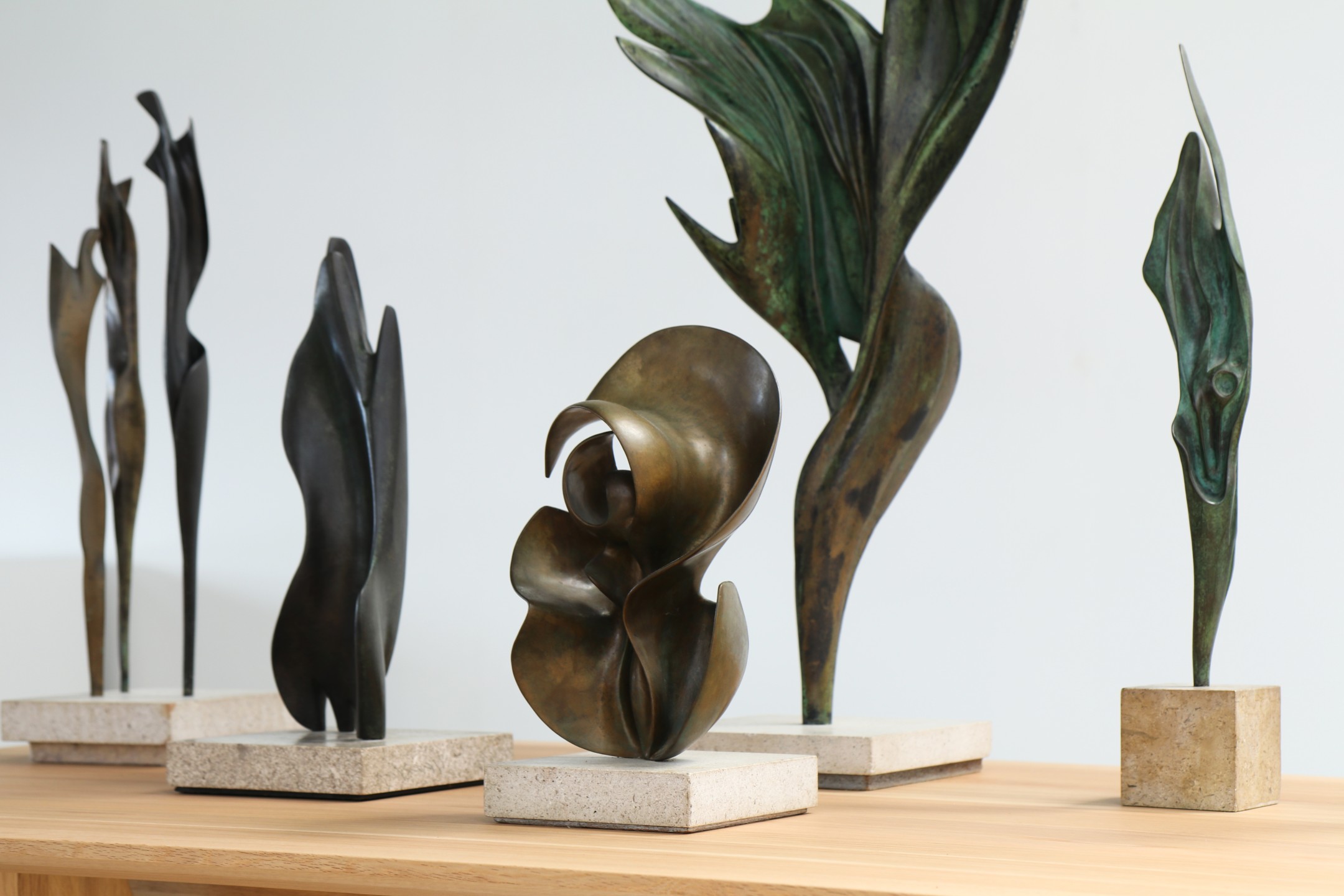
A selection of Edgar Mansfield bronze sculptures on stone bases, brought together for On Creation. Photography: Mr. Bigglesworthy.
For more than a decade, Mr. Bigglesworthy founders Dan and Emma Eagle have sought out and collected bronzes by Edgar Mansfield OBE (1907–1996). They’re now bringing a selection of those works together for On Creation, an exhibition at Good Form in collaboration with Föenander Galleries. The exhibition grew from their conviction that Mansfield’s sculpture deserves to be seen afresh and given a more prominent place in the story of New Zealand modernism.
A bronze by Mansfield rarely reveals itself all at once. A slender form suggests a poised figure. Move a little and an opening catches the light, or a contour brings to mind a bird or an unfolding leaf. His Animism sculptures balance flowing surfaces with taut edges and open spaces that change shape as you move around them. It’s this sense of life, held in bronze, that has kept Dan and Emma returning to the work.
Mansfield’s practice took shape between New Zealand and Britain, at the bookbinder’s bench and in the sculpture studio. His bindings were the subject of Modern Design in Bookbinding and were exhibited at London’s Victoria and Albert Museum. His bronzes, meanwhile, were featured in Sculpture International. Look at the two bodies of work together and the connection becomes clear. The line that travels across a leather cover becomes, in bronze, the edge that guides your eye around a form.
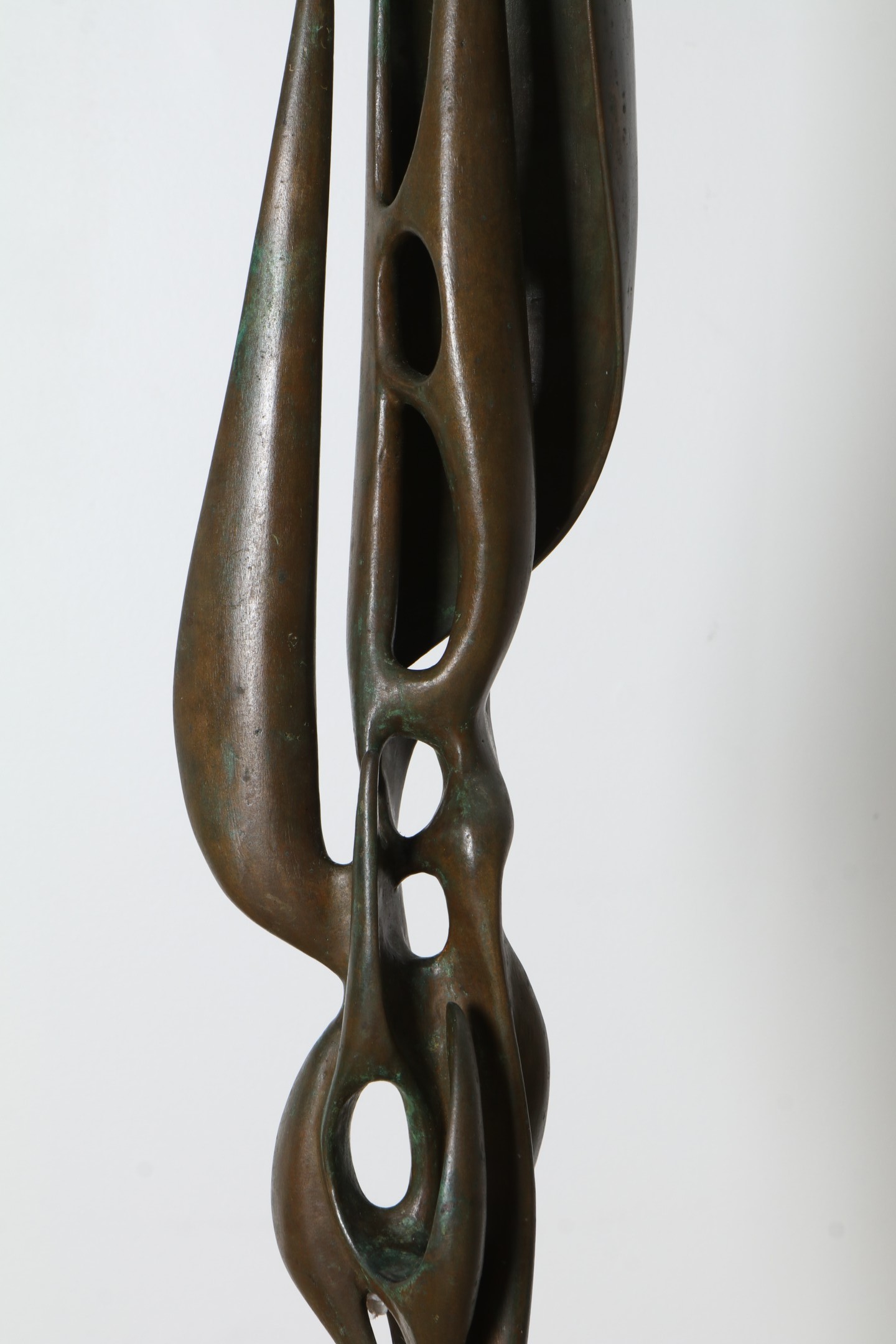
Detail of an Animism bronze by Edgar Mansfield, showing the interplay of line and open space. Photography: Mr. Bigglesworthy.
From Hawke’s Bay to the V&A
Born in London and raised in Hawke’s Bay, Mansfield developed his eye in New Zealand before returning to Britain in 1934 to study design and crafts. His early experience encompassed painting, pottery and teaching. At the London College of Printing, where he taught from 1948 to 1964, colour and design became central to a practice that moved freely between disciplines.
Bookbinding established his international reputation. A co-founder of the Guild of Contemporary Bookbinders in 1955, Mansfield helped transform the book cover into a field for modern artistic expression. Abstract lines, textures and contrasting surfaces gave his bindings the compositional ambition of a painting.
Published by Peter Owen in London in 1966, Modern Design in Bookbinding: The Work of Edgar Mansfield presented his work across 76 full-page plates, with Mansfield’s own notes on design and technique. Its historical introduction was written by Howard M. Nixon, identified on the cover as Deputy Keeper of Books at the British Museum. The volume gave readers an unusually substantial encounter with both the finished bindings and the thinking behind them.
In 1978, the Victoria and Albert Museum presented Two Modern Binders: William Matthews & Edgar Mansfield, organised by Designer Bookbinders. Running from 12 April to 24 June, the exhibition brought Mansfield’s work together with that of his former teacher. The surviving catalogue is a reminder of the standing his bindings had achieved in Britain.
Sculpture was already developing alongside them. Seen together, the bindings and bronzes reveal a sustained fascination with the expressive power of a line. On leather, it travels across a surface. In bronze, it becomes an edge, a rising contour, or the boundary between solid form and open air.

Catalogue for Two Modern Binders: William Matthews & Edgar Mansfield, Victoria and Albert Museum, 12 April–24 June 1978, organised by Designer Bookbinders.
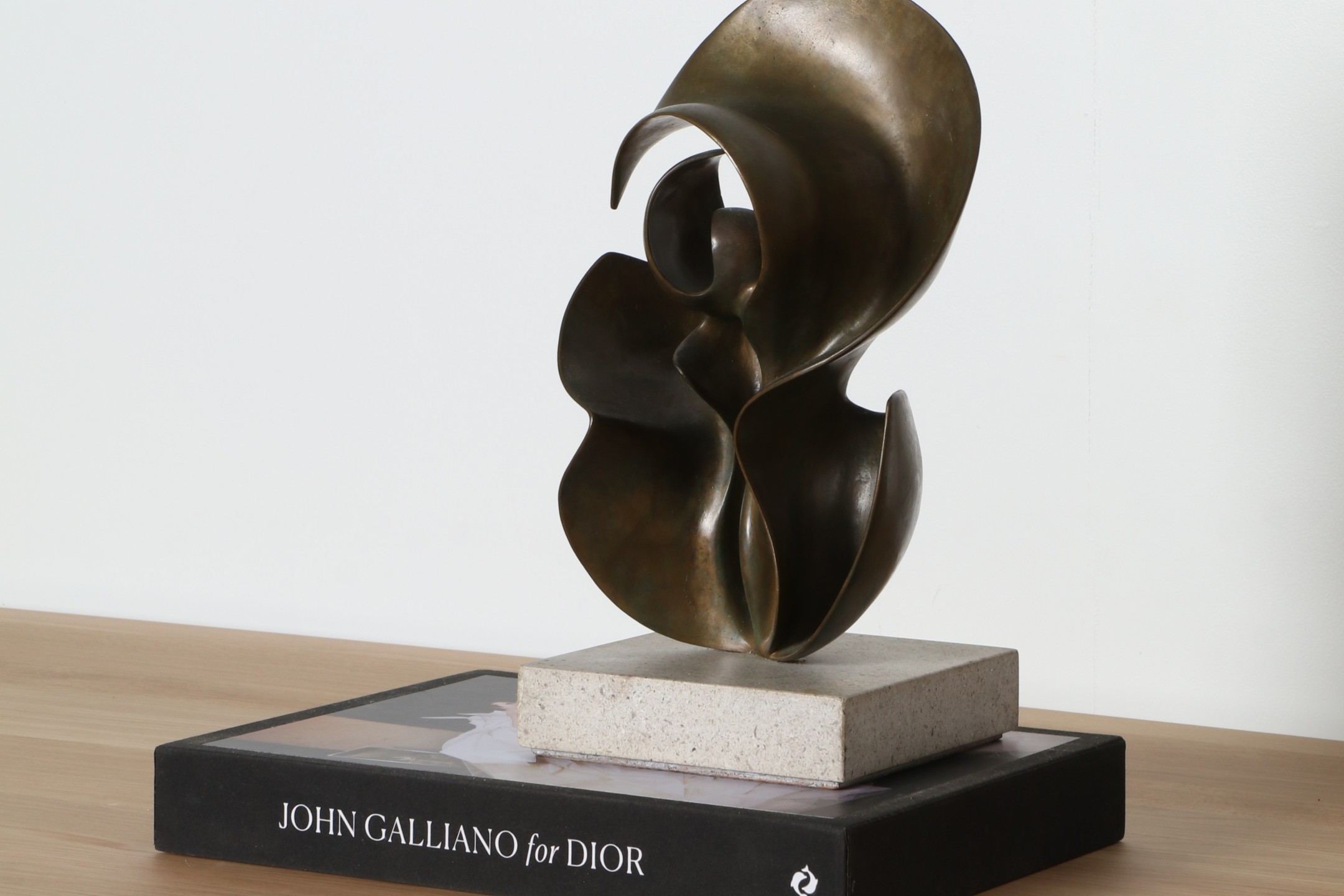
Detail of an Edgar Mansfield bronze, showing its folded, shell-like forms. Photography: Mr. Bigglesworthy.
The artist in his own words
The 1976 New Zealand Potter feature brings us closer to Mansfield’s way of seeing. Across a single spread, a decorated binding appears beside sculpture and a looping linear form. The visual connections are immediate: line, rhythm and space move from one medium to another.
His accompanying account traces his sculpture back to pottery and the possibilities of opening a vessel to reveal its interior. He also recalled driftwood on Napier’s beach, where an inanimate shape could suggest a living presence. His title Animism grew from that imaginative encounter.
Music offers another clue. Having learned the violin as a child, Mansfield connected the structure of his designs with sonata form. Rhythm and variation were part of how he thought about making art. He closed the same account with a more domestic observation: he also grew runner beans, tomatoes and silver beet, and neglected the weeds. Behind the assured compositions was an artist attentive to the forms and pleasures of everyday life.

Sculpture International, vol. 2, no. 3, October 1968. This issue contains J. J. de Lucio Meyer’s feature on Mansfield’s sculpture, pp. 6–13.
A sculptor on an international stage
Mansfield’s bronzes also attracted attention beyond the world of fine binding. In October 1968, Sculpture International devoted a feature to his work, with a text by J. J. de Lucio Meyer on pages 6–13. Meyer recognised the sculptures’ capacity to evoke life without describing it literally, praising their “dynamic form and beauty”.
The text was reproduced in the catalogue for Mansfield’s exhibition at the Govett-Brewster Art Gallery in New Plymouth, held from 28 April to 18 May 1972. Its list of 19 bronzes offers a tangible record of a substantial sculptural practice. Te Papa Tongarewa holds examples of his work, including Animism 27: Rua Tekau Ma Whitu, purchased in 1966, and Animism 60.
The breadth of his achievement was formally recognised in 1979, when he was appointed an Officer of the Order of the British Empire (OBE) for services as a bookbinder and sculptor.
The bronzes themselves remain the most persuasive introduction. A rising point might suggest a beak, a blade or a shoot. Paired forms seem to lean towards one another. As the viewer moves, these associations shift. Mansfield gives the eye enough to recognise while leaving the imagination room to move.

A turn in the contour introduces a sense of movement. Photography: Mr. Bigglesworthy.

Modern Design in Bookbinding: The Work of Edgar Mansfield, Peter Owen, London, 1966. Historical introduction by Howard M. Nixon; technical notes by Mansfield.
Small editions, continuing invention
For collectors, Mansfield’s approach to casting adds another dimension to the work. In his 1976 account, he described bronzes made in editions of six, with the model reworked between successive casts. He called the resulting variations “mutations”. The edition could become a sequence of developing ideas.
This makes close looking especially rewarding. Contour, proportion, openings and surface all contribute to a sculpture’s character. The relationship between one work and another can reveal an artist returning to a problem, testing its possibilities and finding a new resolution.
Looking at Mansfield afresh
Yet his achievement in bookbinding could overshadow the bronzes. Correspondence from 1995–1996, held by the National Library, records his concern that he was being overlooked as a sculptor. Returning to these works today offers an opportunity to consider the breadth of his vision, and to encounter the sculpture on its own terms.
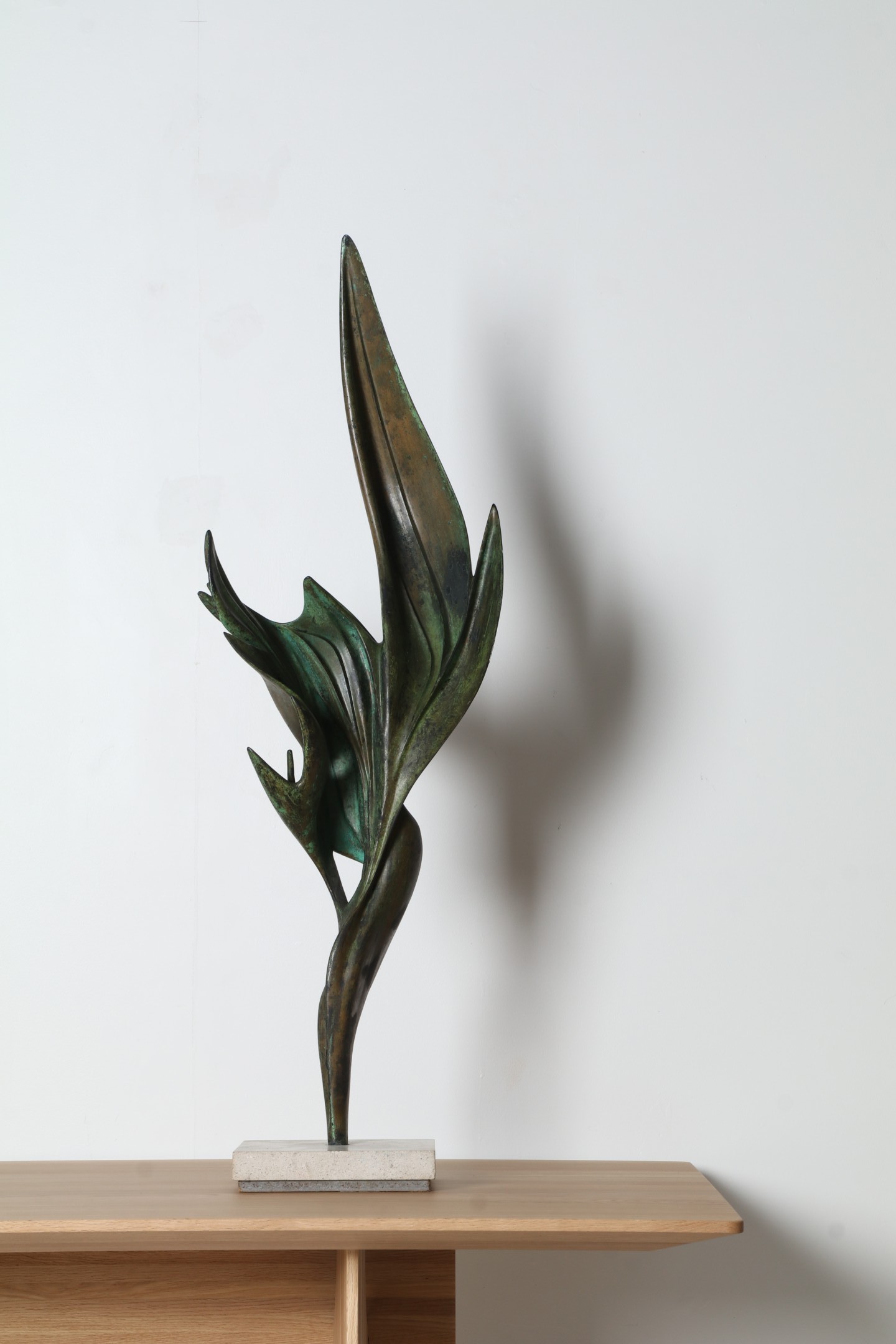
An Edgar Mansfield bronze with sweeping, leaf-like contours and a green patina. Photography: Mr. Bigglesworthy.

Country matters. London: Victor Gollanz, 1937. 4to, bound in natural Nigerian goatskin by Edgar Mansfield, coloured goatskin inlays. Image courtesy of Lyon & Turnbull

Cover of Edgar Mansfield’s Govett-Brewster Art Gallery exhibition catalogue, 28 April–18 May 1972, featuring Animism No. 67.
A decade of looking, brought together
On Creation: Edgar Mansfield & Contemporary Sculpture brings that opportunity into the gallery. Presented collaboratively by Good Form and Föenander Galleries, with Mr. Bigglesworthy, the exhibition places Mansfield’s work in conversation with contemporary sculpture.
For us, it is the culmination of more than ten years of collecting and a chance to share what has kept us looking: the confidence of the forms, their sense of movement, and their capacity to remain open to interpretation. These are sculptures with a distinctive voice and an enduring presence.
View the exhibition at Good Form
86 Newton Road
Eden Terrace
Auckland
From 28 November to 19 December 2026.
Join us for a glass of wine at the opening on Saturday 28 November, 1–3pm.
Explore On Creation or contact us for the catalogue and available works.
Sources and further reading:
Edgar Mansfield, Modern Design in Bookbinding, Peter Owen, 1966; Two Modern Binders: William Matthews & Edgar Mansfield, V&A exhibition catalogue, 1978; Edgar Mansfield, “The art of Edgar Mansfield”, New Zealand Potter, vol. 18, no. 1, Autumn 1976, pp. 32–33; J. J. de Lucio Meyer, Sculpture International, vol. 2, no. 3, October 1968, pp. 6–13, excerpt reproduced in the Govett-Brewster exhibition catalogue, 1972; Auckland Museum, “Bookbinding in Aotearoa”; National Library of New Zealand, Edgar Mansfield biographical record and correspondence; Te Papa collection records for Animism 27 and Animism 60; The London Gazette, 16 June 1979, p. B28.

Biographical notes and exhibition history from Mansfield’s 1972 Govett-Brewster Art Gallery catalogue.
Mansfield is producing three dimensional sculptural adventures which evoke in the imagination the suggestion of life. He is the first sculptor from New Zealand to achieve recognition abroad and to be given one-man exhibitions in this country (U.K.). He is paving the way to a better understanding of contemporary art and his contribution will be of lasting value.